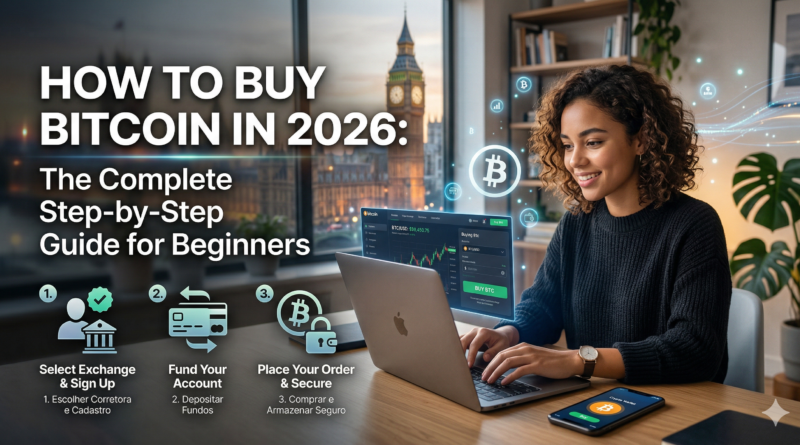
How to Buy Bitcoin in 2026: The Complete Step-by-Step Guide for Beginners
If you’ve been thinking about buying Bitcoin but aren’t sure where to start, you’re in the right place. Whether you’ve heard about it from a coworker, seen it trending on social media, or simply want to understand what the buzz is about, this guide will walk you through how to buy Bitcoin in 2026 clearly, safely, and without any technical jargon.
The good news? Buying Bitcoin today is easier than ever. You don’t need to be a tech genius or have a finance degree. With the right platform and a few straightforward steps, you could own your first Bitcoin — or even just a fraction of one — within the hour.
Let’s get started.
1. What Is Bitcoin and Why Are People Buying It in 2026?
Bitcoin is a decentralized digital currency — often called “digital gold” — that operates without a central bank or government. It was created in 2009, and since then, it has grown from a niche experiment into a globally recognized asset class held by millions of individuals, companies, and even sovereign governments.
So why are so many people buying it right now?
- Store of value: Many investors treat Bitcoin as a hedge against inflation, similar to gold.
- Institutional adoption: Major financial institutions now offer Bitcoin products, lending it more legitimacy.
- Accessibility: You can buy as little as $10 worth of Bitcoin, making it accessible to virtually anyone.
- Decentralization: No single government or bank controls it, which appeals to those who value financial sovereignty.
In 2026, how to buy Bitcoin remains one of the most searched financial topics in the United States. And for good reason — Bitcoin has matured significantly as an asset, and more entry points exist today than ever before.
2. How Much Money Do You Need to Buy Bitcoin?
One of the biggest misconceptions beginners have is that you need to buy a whole Bitcoin. You don’t. Bitcoin is divisible into 100,000,000 units called “satoshis” (or “sats”), which means you can invest any dollar amount you’re comfortable with.
| Investment Amount | What You Get (Approximate) |
| $10 | A small fraction of Bitcoin (~0.000085 BTC at $117,000/BTC) |
| $100 | A slightly larger fraction |
| $500 | A meaningful starter position |
| $1,000+ | A solid entry-level investment |
“You don’t have to buy a full Bitcoin to benefit from its potential. Even small, consistent purchases can build meaningful wealth over time.” — Common wisdom among long-term Bitcoin holders
The most important thing is to invest only what you can afford to lose. Bitcoin is a volatile asset, and its price can swing dramatically in short periods. Starting small while you learn is always the smartest approach.
3. Choosing the Right Platform to Buy Bitcoin
Before you can buy Bitcoin, you need to choose where to buy it. In 2026, there are several types of platforms available to US residents:
Centralized Cryptocurrency Exchanges
These are the most popular and user-friendly options for beginners. They work similarly to stock brokerages — you sign up, verify your identity, deposit funds, and buy Bitcoin.
What to look for in a platform:
- Regulatory compliance with US laws (FinCEN registered, state money transmitter licenses)
- Strong security track record
- FDIC insurance on USD balances (where applicable)
- Transparent fee structure
- Mobile app availability
- Customer support
Peer-to-Peer (P2P) Platforms
These platforms connect buyers and sellers directly, without an intermediary holding your funds. They offer more privacy but require more caution, as scams are more common on P2P marketplaces.
Bitcoin ATMs
Bitcoin ATMs allow you to buy Bitcoin with cash at physical kiosks, available in thousands of locations across the US. They are convenient but typically charge higher fees (ranging from 5% to 20%) compared to online platforms.
Brokerage Apps
Several mainstream investment apps now offer Bitcoin alongside traditional stocks and ETFs. These are excellent options if you’re already using a financial app and want a seamless experience — though you may have less control over your actual Bitcoin.
Pro Tip: For most beginners, a well-established centralized exchange is the easiest and safest starting point. Look for platforms that are transparent about their security practices and have a strong reputation in the US market.
4. Step-by-Step: How to Buy Bitcoin for the First Time
Here is the exact process you’ll follow on virtually any major platform:
Step 1: Create an Account
Visit your chosen platform’s website or download their mobile app. Provide your email address and create a strong, unique password. Enable two-factor authentication (2FA) immediately — this is non-negotiable for security.
Step 2: Verify Your Identity (KYC)
All US-based platforms are required by law to verify your identity before allowing you to buy or sell crypto. This is called “Know Your Customer” (KYC) compliance.
You’ll typically need:
- A government-issued photo ID (driver’s license or passport)
- Your Social Security Number (SSN)
- A selfie or live photo
- Your address
Most verifications are completed within minutes, though some may take up to 24 hours.
Step 3: Deposit Funds
Link your bank account via ACH transfer (usually free but takes 1-5 business days), or use a debit card (instant but with a small fee). Some platforms also accept wire transfers for larger amounts.
Step 4: Place Your Bitcoin Order
Navigate to the Buy/Sell section of your platform and select Bitcoin (BTC). Enter the dollar amount you want to spend. Review the transaction details, including the exchange rate and fees, then confirm your purchase.
Step 5: Decide Where to Store Your Bitcoin
After purchasing, you can leave your Bitcoin on the platform (convenient but carries counterparty risk) or transfer it to a personal wallet (more secure, but requires more responsibility). We’ll cover this in depth in the next section.
5. Bitcoin Wallets Explained: Where to Store Your Bitcoin Safely
After you buy Bitcoin, it needs to live somewhere. That “somewhere” is a Bitcoin wallet.
A wallet doesn’t actually store your Bitcoin — it stores the private keys that prove you own the Bitcoin recorded on the blockchain. Think of it like a safe that holds the deed to your property, rather than the property itself.
Types of Bitcoin Wallets
- Exchange Wallets (Custodial): Your Bitcoin stays on the exchange. The platform holds the private keys on your behalf. Easy and convenient, but you’re trusting a third party.
- Software Wallets (Non-Custodial): Apps on your phone or computer where you control the private keys. More secure than exchange wallets, still connected to the internet.
- Hardware Wallets (Cold Storage): Physical devices (resembling USB drives) that store your private keys offline. The gold standard for security.
- Paper Wallets: Printed QR codes containing your keys. Old-fashioned but immune to digital hacking.
6. Hot Wallets vs. Cold Wallets: Which One Should You Use?
The terms “hot” and “cold” refer to whether a wallet is connected to the internet.
| Feature | Hot Wallet | Cold Wallet |
| Internet Connection | Yes | No |
| Convenience | High | Lower |
| Security | Moderate | Very High |
| Cost | Usually Free | $50–$200 |
| Best For | Small amounts, frequent use | Long-term storage, large amounts |
The general rule: If you’re actively trading or holding a small amount, a reputable software wallet is fine. If you’re holding a significant sum that you plan to keep long-term, invest in a hardware wallet. Your Bitcoin’s security is ultimately your responsibility.
7. How to Keep Your Bitcoin Safe from Hackers and Scams
The decentralized nature of Bitcoin is a feature — but it also means there’s no “undo button” if you send funds to the wrong address or fall for a scam. Security is absolutely critical.
Top Security Practices for Bitcoin Owners
- Use a strong, unique password for every crypto account. Use a password manager.
- Enable two-factor authentication (2FA) — preferably with an authenticator app, not SMS.
- Never share your seed phrase (the 12-24 recovery words for your wallet) with anyone, ever. No legitimate service will ever ask for it.
- Beware of phishing emails that mimic exchanges. Always navigate to platforms by typing the URL directly.
- Use a hardware wallet for any amount you can’t afford to lose.
- Be skeptical of “too good to be true” offers: If someone promises to double your Bitcoin, it’s a scam. Always.
- Keep your software updated — this applies to your wallet app, your phone’s OS, and your computer.
“Not your keys, not your coins.” — A foundational principle in the Bitcoin community, emphasizing the importance of controlling your own private keys.
8. Understanding Bitcoin Fees: What You’ll Actually Pay
Fees are an often-overlooked part of buying Bitcoin. Here’s a breakdown of what to expect:
Exchange/Platform Fees
Most platforms charge a percentage of each transaction. Fees typically range from 0.1% to 1.5% for standard purchases. Debit card purchases often cost more than ACH/bank transfers.
Network (Miner) Fees
When you send Bitcoin from one wallet to another, you pay a small fee to the Bitcoin network’s miners (or validators). These fees fluctuate based on network congestion. During peak times, they can be higher.
Bitcoin ATM Fees
As mentioned earlier, Bitcoin ATMs are convenient but expensive — factor in fees of 5%–20% at the point of purchase.
Spread
Some platforms profit from the “spread” — the difference between the price they buy Bitcoin at and the price they sell it to you at. Always check whether a platform charges a spread in addition to stated fees.
Bottom line: For most beginner buyers using an exchange, you can expect to pay between 0.5% and 2% per transaction all-in. Minimize costs by using bank transfers over debit cards when possible.
9. Tax Implications of Buying Bitcoin in the US (2026)
The IRS treats Bitcoin as property, not currency. This has important tax implications that every American Bitcoin buyer must understand.
Key Tax Rules for Bitcoin in the US
- Buying Bitcoin is NOT a taxable event — you don’t owe taxes when you purchase.
- Selling Bitcoin IS a taxable event — you’ll owe capital gains tax on any profit.
- Short-term capital gains apply if you held for less than one year (taxed as ordinary income).
- Long-term capital gains apply if you held for more than one year (lower rates: 0%, 15%, or 20% depending on income).
- Using Bitcoin to buy goods/services is also a taxable event.
- Receiving Bitcoin as income (e.g., from mining or work) is taxed as ordinary income.
Essential Tax Tips
- Keep meticulous records of every transaction — date, amount, price at purchase, and price at sale.
- Use reputable crypto tax software to automate your reporting.
- Consult a tax professional familiar with cryptocurrency — the rules continue to evolve.
Note: This section provides general educational information only. It is not tax advice. Always consult a qualified tax professional for guidance specific to your situation.
10. Common Mistakes Beginner Bitcoin Buyers Make
Learning from others’ mistakes is far less painful than making your own. Here are the most common pitfalls first-time Bitcoin buyers encounter:
- Investing money they can’t afford to lose: Bitcoin is volatile. Only invest discretionary capital.
- Leaving large amounts on exchanges: Exchanges can be hacked or go bankrupt. Move significant holdings to personal wallets.
- Losing their seed phrase: If you lose your wallet’s recovery phrase and your device fails, your Bitcoin is gone forever. Store it somewhere extremely secure — offline, not in a screenshot.
- Falling for scams: Giveaway scams, impersonation, and Ponzi schemes are rampant in the crypto space. Be deeply skeptical.
- Panic selling during dips: Bitcoin’s price history is full of dramatic drops followed by new highs. Emotional selling has cost many investors significant gains.
- Ignoring fees: Small percentage fees add up significantly over time and multiple transactions.
- Skipping 2FA: This one simple step prevents the vast majority of account hacks.
11. Should You Buy Bitcoin All at Once or Dollar-Cost Average?
This is one of the most common questions for new Bitcoin investors, and the answer depends on your risk tolerance and goals.
Lump Sum Investing
Buying a large amount at once means you benefit maximally if the price goes up immediately — but you also take on full risk if the price drops right after your purchase. Best for: highly conviction investors who’ve done their research and have a long time horizon.
Dollar-Cost Averaging (DCA)
DCA means buying a fixed dollar amount of Bitcoin at regular intervals — say, $50 every week regardless of price. This strategy:
- Reduces the impact of short-term volatility
- Removes the emotional stress of timing the market
- Builds a position gradually over time
- Is ideal for beginners and those with a steady income
Many long-term Bitcoin holders swear by DCA. Most major platforms allow you to set up automatic recurring purchases, making the process completely hands-off.
“Time in the market beats timing the market” — A principle that applies equally well to Bitcoin as it does to traditional investing.
12. Bitcoin vs. Other Cryptocurrencies: Should You Diversify?
Once you’ve bought Bitcoin, you’ll inevitably encounter hundreds of other cryptocurrencies — often called “altcoins.” Should you branch out?
Why Bitcoin Remains the Starting Point
- Bitcoin has the longest track record, the most liquidity, and the widest institutional adoption.
- It’s the most regulated and legally recognized cryptocurrency in the US.
- Its supply is capped at 21 million coins, creating inherent scarcity.
Considerations Before Buying Altcoins
Altcoins carry significantly higher risk than Bitcoin. Many projects have failed entirely, taking investors’ money with them. The general advice for beginners: get comfortable with Bitcoin first. If you later decide to explore other cryptocurrencies, do thorough research and allocate only a small percentage of your portfolio.
Never invest in a cryptocurrency based solely on social media hype or the advice of strangers online.
13. How to Track Your Bitcoin Investment
Staying informed about your investment doesn’t mean obsessively checking prices every hour — that leads to anxiety and poor decisions. Instead, use tools that give you a clear picture without overwhelming you.
Recommended Tracking Tools
- Portfolio tracker apps: Many mobile apps allow you to input your holdings and track their value in real time without linking to your exchange accounts.
- Exchange dashboards: Your platform’s built-in dashboard shows your holdings, transaction history, and performance.
- Bitcoin-specific news aggregators: Stay informed about major developments that could affect Bitcoin’s price and regulatory environment.
- Crypto tax software: These platforms double as tracking tools, automatically pulling in your transaction history.
Set a schedule: Check your portfolio weekly or monthly rather than daily. Bitcoin’s volatility can make daily checking emotionally exhausting and counterproductive.
14. What to Do After You Buy Bitcoin
Buying Bitcoin is just the beginning. Here’s what smart investors do next:
- Secure your account: Confirm 2FA is enabled, your password is strong, and your recovery codes are saved.
- Record your purchase: Note the date, amount, and price paid for future tax reporting.
- Consider your storage strategy: Decide whether to keep your Bitcoin on the exchange or transfer it to a personal wallet.
- Set realistic expectations: Bitcoin is a long-term asset for most people. Avoid making decisions based on short-term price movements.
- Keep learning: The more you understand about Bitcoin — its technology, economics, and ecosystem — the better decisions you’ll make.
- Tell no one (or be selective): Discussing your Bitcoin holdings publicly or with untrustworthy people creates unnecessary risk. Financial privacy is part of good security practice.
15. Frequently Asked Questions About Buying Bitcoin in 2026
Q1: Is it safe to buy Bitcoin in the US right now?
Yes, buying Bitcoin through reputable, regulated US platforms is generally considered safe in 2026. The key is choosing well-established platforms that comply with US regulations, enabling strong security measures on your account, and practicing good personal security hygiene. The risk lies not in Bitcoin itself but in how you manage your access to it.
Q2: Can I buy Bitcoin with my credit card?
Some platforms allow credit card purchases of Bitcoin, but this is generally inadvisable. Credit card companies typically classify crypto purchases as cash advances, which carry higher interest rates and no grace period. Additionally, using credit to buy a volatile asset adds significant financial risk. Stick to bank transfers or debit cards.
Q3: What is the minimum amount of Bitcoin I can buy?
Most platforms allow you to purchase as little as $1 to $10 worth of Bitcoin. Since Bitcoin is divisible into 100 million units (satoshis), there is no practical minimum from a technical standpoint — only from a platform policy standpoint. Starting small is perfectly reasonable and encouraged for beginners learning how to buy Bitcoin.
Q4: How do I know if a Bitcoin platform is legitimate?
Look for platforms that are registered with FinCEN (the US Financial Crimes Enforcement Network), hold money transmitter licenses in the states they operate, and have a verifiable track record. Avoid platforms that promise guaranteed returns, pressure you to invest quickly, or request unusual payment methods. Reading independent user reviews and checking regulatory databases are good first steps.
Q5: What happens to my Bitcoin if the exchange goes bankrupt?
This is a real risk, and it’s why security experts recommend not keeping large amounts of Bitcoin on exchanges long-term. If an exchange goes bankrupt, your assets may be caught up in legal proceedings. To protect yourself, transfer meaningful amounts of Bitcoin to a self-custodied wallet — one where you control the private keys — so your holdings are never at risk from a third party’s financial troubles.
Conclusion: Your Bitcoin Journey Starts With One Step
Buying Bitcoin in 2026 is simpler, safer, and more accessible than it has ever been. The barriers that once made crypto intimidating — confusing technology, limited platforms, unclear regulations — have largely been addressed. What remains is the most important part: your decision to start.
To recap the three most important things to take away from this guide:
- Start small and learn as you go — You don’t need to invest thousands of dollars to get meaningful exposure to Bitcoin.
- Security is everything — Enable 2FA, use strong passwords, and consider a hardware wallet for significant holdings.
- Think long-term — Bitcoin has rewarded patient, disciplined investors far more consistently than those chasing short-term gains.
Whether you invest $50 or $5,000, the most valuable thing you can do today is take one concrete step: choose a reputable platform, create an account, and make your first purchase. The knowledge you gain from that first transaction is worth more than any amount of reading.
Your journey into Bitcoin starts now.
This article is for informational purposes only and does not constitute financial or investment advice. Always conduct your own research and consult a qualified financial advisor before making investment decisions.
Internal Linking Opportunities
- “What is a Bitcoin wallet” → link to wallet explainer article
- “dollar-cost averaging strategy” → link to DCA investment guide
- “Bitcoin tax reporting” → link to crypto tax guide
- “best Bitcoin security practices” → link to security deep-dive
- “Bitcoin vs. Ethereum comparison” → link to altcoin comparison article
- “how to read crypto charts” → link to technical analysis beginner guide
- “Bitcoin ATM near me” → link to Bitcoin ATM locator tool
Schema Markup Recommendations
- Article schema: Apply to the full article for rich snippet eligibility
- FAQ schema: Apply to the FAQ section (Section 15) for “People Also Ask” box eligibility
- HowTo schema: Apply to Section 4 (Step-by-Step guide) for enhanced SERP display
- BreadcrumbList schema: Apply to navigation for site structure clarity