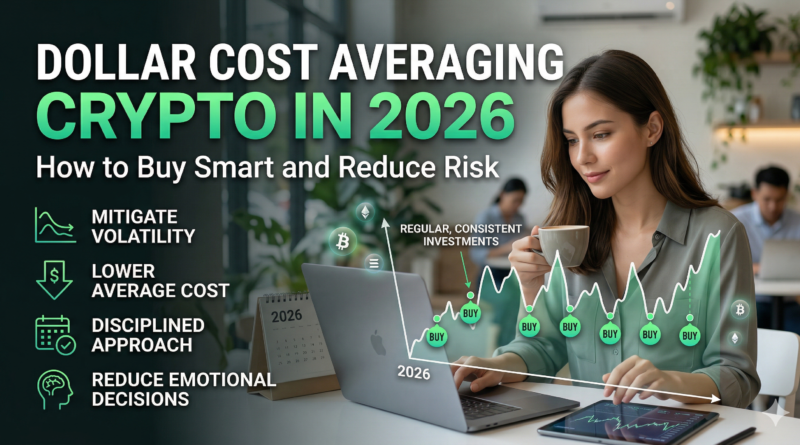
Dollar Cost Averaging Crypto in 2026: How to Buy Smart and Reduce Risk
Trying to figure out the perfect moment to buy crypto is like trying to catch lightning in a bottle. Prices swing wildly, headlines flip from euphoric to apocalyptic overnight, and even seasoned traders get burned trying to time the market. There’s a smarter way to play this game — and it doesn’t require you to predict the future.
Dollar cost averaging crypto is one of the most powerful, battle-tested strategies for building long-term digital asset exposure without the emotional and financial pain of buying at the wrong time. Whether you’re a complete beginner or a seasoned investor looking to systematize your approach, 2026 is a compelling time to understand and apply this method.
In this guide, we break down exactly how DCA works in the crypto market, why it outperforms emotion-driven investing for most people, and how to build a smart, personalized DCA plan starting today.
What Is Dollar Cost Averaging Crypto?
Dollar cost averaging crypto (DCA) is an investment strategy where you buy a fixed dollar amount of a cryptocurrency at regular intervals — regardless of the current price. Instead of trying to buy all at once at the “right” moment, you spread your purchases over time.
Here’s the core idea: when prices are high, your fixed dollar amount buys fewer coins. When prices are low, that same amount buys more. Over time, your average purchase price smooths out, reducing the impact of any single bad entry point.
This approach originated in traditional stock market investing decades ago. Today, it’s one of the most widely recommended strategies for crypto investing — and for good reason.
“Trying to time the market consistently is a fool’s errand. A disciplined, consistent investment strategy almost always outperforms reactive decision-making over the long run.” — A sentiment echoed by virtually every credible financial educator in the crypto space.
Why 2026 Is a Critical Year for Crypto DCA Strategy
The crypto landscape in 2026 looks fundamentally different from just a few years ago. Institutional adoption has accelerated, regulatory clarity has improved in major markets, and the asset class has matured significantly. Yet volatility remains — and that’s actually good news for DCA investors.
Here’s what makes 2026 particularly interesting for dollar cost averaging crypto:
- Post-halving dynamics: Bitcoin’s most recent halving event has historically preceded major appreciation cycles. DCA investors who stayed consistent through the bear phase are now positioned well.
- Expanding altcoin market: The market cap of assets beyond Bitcoin has grown, giving DCA investors more diversification options within crypto.
- Better infrastructure: Automated recurring purchase tools have become standard across major platforms, making it easier than ever to set and maintain a DCA strategy.
- Increased mainstream awareness: More Americans are exploring crypto as part of their broader investment strategy, and DCA provides a sensible entry point.
The combination of continued volatility and growing long-term optimism creates exactly the environment where DCA crypto strategy shines.
How Dollar Cost Averaging Crypto Works: A Step-by-Step Breakdown
Understanding the mechanics helps you apply the strategy with confidence. Here’s how dollar cost averaging Bitcoin or any other crypto asset works in practice:
Step 1: Choose Your Asset (or Assets)
Start by deciding which cryptocurrency — or combination — you want to accumulate. Most DCA strategies in 2026 focus on:
- Bitcoin (BTC) — the most established, highest liquidity
- Ethereum (ETH) — strong fundamentals, smart contract utility
- A diversified basket — spreading smaller amounts across several assets
For beginners, starting with Bitcoin or Ethereum reduces complexity while still providing meaningful exposure to the asset class.
Step 2: Set Your Investment Amount
Decide how much you’ll invest per period. This should be an amount you’re comfortable not touching for years — money you can genuinely afford to set aside. Common DCA amounts among US investors range from $25 to $500 per interval.
Be realistic. A consistent $50 per week beats an inconsistent $500 whenever you “feel good” about the market.
Step 3: Choose Your Frequency
How often will you buy? The most common DCA intervals are:
- Weekly — smooths out short-term volatility most effectively
- Bi-weekly — aligns nicely with paycheck schedules
- Monthly — simpler to manage, still highly effective
Research consistently shows that weekly DCA outperforms monthly DCA in highly volatile markets like crypto — though the difference often matters less than staying consistent over years.
Step 4: Automate the Process
Set up recurring purchases through your platform of choice. Automation removes the single biggest enemy of DCA: your own emotions. When prices drop 30%, the temptation to pause or panic-sell is real. Automated purchases keep you on track regardless of market sentiment.
Step 5: Stay the Course (This Is the Hard Part)
The most important step is also the simplest to understand but hardest to execute. You must keep buying through bear markets, corrections, and long sideways periods. The investors who benefited most from DCA into Bitcoin between 2018 and 2020 were the ones who didn’t stop during the painful stretches.
Dollar Cost Averaging vs. Lump Sum: Which Wins in Crypto?
This is one of the most debated questions in crypto investing circles. Let’s break it down honestly.
| Factor | Dollar Cost Averaging | Lump Sum Investing |
| Risk of bad timing | Low — spread across many entry points | High — single entry point |
| Potential upside in bull run | Moderate — you miss some of the bottom | High — if you buy right before rally |
| Emotional difficulty | Low — automated, consistent | High — requires conviction at purchase |
| Best market condition | Volatile or downtrending markets | Strongly uptrending markets |
| Ideal investor profile | Most people with regular income | Experienced investors with large capital |
| Average outcome vs. perfect timing | Better for 80%+ of investors | Rarely achievable in practice |
Here’s the honest truth: if you could perfectly time lump-sum entries, you’d outperform DCA. But perfect timing doesn’t exist — and the psychological burden of committing a large sum at once leads most investors to either hesitate too long or buy at peaks driven by FOMO.
For the vast majority of American investors looking at dollar cost averaging crypto in 2026, DCA wins on a risk-adjusted basis.
“The best investment strategy is the one you can actually stick to — not the one that’s theoretically optimal.”
How to Calculate Your DCA Performance
Let’s look at a concrete example to illustrate how DCA crypto strategy plays out over time.
Imagine you invest $100 per week into Bitcoin over 10 weeks at the following prices:
| Week | BTC Price | Amount Invested | BTC Purchased |
| 1 | $60,000 | $100 | 0.00167 BTC |
| 2 | $55,000 | $100 | 0.00182 BTC |
| 3 | $48,000 | $100 | 0.00208 BTC |
| 4 | $42,000 | $100 | 0.00238 BTC |
| 5 | $45,000 | $100 | 0.00222 BTC |
| 6 | $50,000 | $100 | 0.00200 BTC |
| 7 | $58,000 | $100 | 0.00172 BTC |
| 8 | $62,000 | $100 | 0.00161 BTC |
| 9 | $65,000 | $100 | 0.00154 BTC |
| 10 | $70,000 | $100 | 0.00143 BTC |
Total invested: $1,000
Total BTC accumulated: ~0.01847 BTC
Average purchase price: ~$54,141
Value at week 10 price: ~$1,293
Despite starting at $60,000 and ending at $70,000, the DCA investor’s average cost is nearly $6,000 lower per BTC than the week 1 price — because they bought more during the dip in weeks 3 and 4.
The Psychology Behind DCA: Why It Works When Others Fail
One of the most underappreciated aspects of dollar cost averaging crypto is what it does to your brain. Crypto investing is notorious for triggering extreme emotional responses — panic during crashes, euphoria during rallies. Both emotions lead to poor decisions.
DCA systematically removes the need to make a decision at all. You’ve already decided. The amount is set. The frequency is set. The purchase happens automatically. This has several powerful psychological effects:
It removes fear of “bad timing.” Since you’re buying at multiple price points, no single entry point defines your position. The anxiety of “what if I buy right before a crash” evaporates.
It keeps you invested during bear markets. This is enormous. Most retail investors stop buying — or sell — during prolonged downturns. DCA investors keep accumulating, which is exactly when the best long-term buys are made.
It prevents FOMO-driven lump sums. When Bitcoin surges 40% in a week, the temptation to pour in everything you have is real. DCA disciplines you to stick to your plan instead of chasing momentum.
It creates a positive habit loop. Regular investing builds a relationship with your portfolio that’s constructive rather than reactive.
Common DCA Mistakes to Avoid in 2026
Even disciplined DCA investors can undermine their strategy with a few key mistakes. Watch out for these:
1. Stopping During Bear Markets
This is the single biggest DCA killer. Bear markets feel awful, but they’re when DCA works best — you’re accumulating more at lower prices. Stopping your purchases is the equivalent of turning off a sale halfway through shopping.
2. Panic-Selling Your Accumulated Position
DCA is a long-term accumulation strategy. Selling everything during a 40% correction reverses all the disciplined buying you’ve done. Set expectations clearly: crypto is a multi-year investment when using DCA.
3. Investing Money You Can’t Afford to Lock Up
If you need the money within 12–18 months, DCA into volatile assets like crypto isn’t appropriate. Only DCA with funds you genuinely won’t need for years.
4. Over-Diversifying Into Obscure Assets
DCA works best with assets that have strong long-term fundamentals and real liquidity. Spreading $50/week across 15 different micro-cap tokens creates complexity without meaningful risk reduction.
5. Neglecting Security
Accumulating crypto over time creates a growing portfolio that needs proper security. Use hardware wallets for significant holdings, enable two-factor authentication everywhere, and be thoughtful about custody.
DCA Crypto Strategy: Frequency Matters More Than You Think
Should you DCA weekly or monthly? The research, including backtesting across multiple crypto market cycles, consistently shows that higher frequency DCA (weekly or bi-weekly) outperforms monthly in volatile markets.
Here’s why: in a market that can move 10–20% in a single week, buying monthly leaves larger windows where you’re exposed to single-entry risk. Weekly purchases smooth out those movements far more effectively.
That said, the most important factor isn’t frequency — it’s consistency. A monthly DCA that you stick to for five years will dramatically outperform a weekly DCA that you abandon after six months.
Practical recommendation for 2026:
- Income paid bi-weekly? Match your DCA frequency to your paycheck.
- Prefer simplicity? Monthly DCA is perfectly solid.
- Want maximum volatility smoothing? Set weekly purchases.
How to Set Up a DCA Crypto Strategy in 2026
Getting started is simpler than most people expect. Here’s a practical framework:
Define Your Goal First
Are you building long-term wealth? Saving for a specific milestone in 5–10 years? Creating a hedge against currency inflation? Your goal shapes your asset selection, time horizon, and amount.
Choose a Platform With Recurring Buy Features
Major platforms now offer “auto-buy” or recurring purchase features that execute on your schedule. Look for platforms with:
- Low fees on recurring purchases
- FDIC-insured fiat balances
- Strong security track record
- Easy portfolio tracking
Set Your Amount and Frequency
Start with whatever you can commit to consistently. It’s better to DCA $25/week reliably than $200/month inconsistently. You can always increase over time as your financial situation improves.
Create a “Don’t Touch” Rule
Define the conditions under which you would sell. Stick to them. Many DCA investors set a simple rule: don’t sell unless the fundamental investment thesis changes — not just because the price dropped.
Review Annually, Not Daily
Checking your crypto portfolio daily is a recipe for anxiety-driven decisions. Set calendar reminders to review your strategy quarterly or annually, and otherwise let the automation do its work.
DCA vs. Active Trading: An Honest Comparison
Many newcomers to crypto are attracted to active trading — buying and selling on short-term price movements. How does this compare to a disciplined DCA strategy?
| Metric | DCA Strategy | Active Trading |
| Time required | Minimal (set and forget) | High — hours per day |
| Skill required | Low — consistency matters most | Very high — technical analysis, discipline |
| Average performance vs. market | Competitive with market returns | Most traders underperform over 3+ years |
| Tax complexity | Low — fewer taxable events | High — every trade is potentially taxable |
| Stress level | Low | Very high |
| Suitable for | Most investors | Experienced traders with dedicated time |
The data on active traders is sobering. Studies across traditional and crypto markets consistently show that the majority of active retail traders underperform simple buy-and-hold or DCA strategies over meaningful time horizons.
Unless trading is your profession or passion (and you have the discipline and knowledge to support it), dollar cost averaging crypto is almost certainly the better path for long-term wealth building.
Tax Considerations for DCA Crypto Investors in the US
DCA creates multiple taxable lots — each purchase is a separate tax event when you eventually sell. In 2026, US tax rules for crypto remain largely based on property treatment established by IRS guidance.
Key points to know:
- Each purchase creates a new cost basis. When you sell, the IRS wants to know exactly what you paid for the coins being sold.
- Holding over 12 months qualifies for long-term capital gains rates. This is a significant advantage — rates are typically lower than short-term rates.
- Good records are essential. Your platform should provide transaction history, but maintaining your own records is wise.
- Automated purchases are not exempt from reporting. Every DCA purchase is a taxable acquisition that must be tracked.
Consult with a tax professional familiar with cryptocurrency before making significant investment decisions. Tax treatment can significantly impact your net returns.
Building a Long-Term DCA Portfolio: Asset Allocation Ideas
If you’re committed to DCA crypto strategy for the long term, consider how to structure your allocation across different assets.
Conservative DCA Portfolio (Lower Volatility)
- 80% Bitcoin
- 20% Ethereum
Balanced DCA Portfolio (Moderate Risk)
- 60% Bitcoin
- 30% Ethereum
- 10% diversified across other established assets
Growth DCA Portfolio (Higher Risk/Reward)
- 50% Bitcoin
- 30% Ethereum
- 20% diversified across sector-specific assets (DeFi, infrastructure, etc.)
There’s no universally “right” allocation — it depends on your risk tolerance, time horizon, and existing financial situation. What matters is choosing an allocation you’ll stick to through volatility and rebalancing periodically (once or twice per year is usually sufficient).
The Long Game: What DCA Crypto Investors in 2026 Should Expect
Patience is the core competency of successful DCA investing. Here’s a realistic framework for what to expect:
Year 1: You’ll likely see volatility that tests your conviction. Some weeks will feel discouraging. Stay automated. Don’t check prices obsessively.
Years 2–3: Your average cost basis becomes increasingly clear. If you’ve been consistent, you’ll likely see your position growing in both quantity and value, even through down periods.
Years 4–5+: This is where the compounding of consistent accumulation becomes genuinely visible. Investors who started DCA programs in 2019 or 2020 and stayed consistent through volatility have seen remarkable long-term results.
No one can promise specific returns. Crypto remains a high-risk asset class. But the historical evidence for long-term accumulation strategies in Bitcoin and Ethereum specifically is one of the most compelling stories in modern investing.
Internal Linking Opportunities
For publishers integrating this content into a broader crypto or investment site, consider linking to:
- “Best Crypto Platforms for Beginners 2026” — anchor: best platforms for automated crypto purchases
- “Bitcoin Halving Explained: What It Means for Investors” — anchor: post-halving dynamics
- “Crypto Tax Guide for US Investors 2026” — anchor: tax considerations for DCA investors
- “How to Store Crypto Safely: Hardware Wallets Guide” — anchor: hardware wallets for significant holdings
- “DeFi vs. Traditional Crypto: What’s the Difference?” — anchor: sector-specific assets
- “Long-Term Crypto Investing: A Beginner’s Roadmap” — anchor: long-term wealth building
- “Ethereum in 2026: Is It Still Worth Buying?” — anchor: dollar cost averaging Ethereum
Conclusion: Why Dollar Cost Averaging Crypto Makes Sense in 2026
Crypto markets in 2026 offer a compelling combination of matured infrastructure, growing institutional adoption, and continued price volatility — exactly the conditions that favor a disciplined dollar cost averaging crypto strategy over reactive, emotion-driven investing.
The three core takeaways from everything we’ve covered:
- Consistency beats perfect timing. No one can predict crypto prices reliably. Steady, automated purchases across multiple price points produce better risk-adjusted outcomes for most investors.
- Automation removes your worst enemy. Your emotions — panic, FOMO, analysis paralysis — are the biggest threat to long-term crypto investment success. DCA automation sidesteps all of them.
- Time in the market beats timing the market. The investors who started DCA programs years ago and stuck with them through volatility are the ones who have the strongest positions today.
Set your amount. Choose your frequency. Automate it. Then get back to living your life.
Frequently Asked Questions
What is the best amount to dollar cost average into crypto as a beginner?
There’s no single right answer, but a practical guideline is to start with an amount you genuinely won’t miss — something that feels slightly uncomfortable but sustainable. For many beginners, $25–$100 per week is a sensible range. The exact amount matters far less than your consistency over time. Start small if you’re unsure, and increase your contributions as your financial confidence grows and your understanding of the asset deepens.
Is dollar cost averaging crypto worth it in 2026?
For most long-term investors, yes. DCA removes the stress of market timing, reduces the impact of volatility on your average cost, and creates a disciplined accumulation habit. In 2026, with improved platform tools, better regulatory clarity, and continued institutional interest in digital assets, the infrastructure for DCA crypto investing is stronger than it’s ever been. It’s particularly well-suited for investors who want crypto exposure without dedicating significant time to active market monitoring.
How often should I dollar cost average into crypto — weekly or monthly?
Weekly DCA generally provides better volatility smoothing than monthly in crypto markets, which can move dramatically in short periods. However, the most important factor is consistency. If a monthly schedule fits your financial workflow better and you’re more likely to stick with it, monthly DCA is excellent. Many investors align their DCA frequency with their pay cycle — bi-weekly purchases timed to paychecks are a popular middle ground between weekly smoothing and monthly simplicity.
Can I dollar cost average into multiple cryptocurrencies at once?
Absolutely. Many investors split their DCA allocation across Bitcoin and Ethereum, with smaller amounts in other assets. The key is to keep your diversification manageable. Splitting a small monthly budget across too many assets creates complexity without meaningful risk reduction. Start with one or two assets, get comfortable with the strategy, and expand your allocation thoughtfully as your portfolio grows and your knowledge deepens.
What happens to my DCA crypto strategy during a bear market?
A bear market is actually where DCA performs at its best — you’re accumulating more coins per dollar as prices fall. The challenge is psychological: it feels counterintuitive to keep investing when your portfolio is down significantly. The investors who maintained their DCA programs during major crypto bear markets historically ended up with much stronger positions when markets recovered. If you’ve set up automation, the best thing you can do during a bear market is nothing — let the system keep buying on your behalf.
This article is for educational and informational purposes only. It does not constitute financial or investment advice. Cryptocurrency investments carry significant risk, including the possible loss of principal. Always consult a qualified financial professional before making investment decisions.